
Request A Quote
Industry Insights & Apparel News

Apparel & Fashion Manufacturing Blog

Stay updated with the latest fashion trends, private label manufacturing guides, and wholesale clothing business strategies.

0%

Choosing the right Custom Puffer Jackets supplier requires more than comparing attractive product photos. Global buyers must examine insulation, fabric performance, stitching quality, sizing accuracy, and production consistency. A jacket may look warm in a studio image but feel thin in freezing wind. Real evaluation begins with samples, technical specifications, and honest communication.

This guide introduces leading options for buyers seeking dependable custom outerwear. It considers recycled polyester, down, and synthetic filling, alongside water-resistant shells and durable zippers. Supplier experience matters. So does the ability to manage color matching, logo placement, private labels, packaging, and regional size standards. Ask for test reports when performance claims involve warmth, water resistance, or material composition. Check factory records, sample revisions, and quality-control procedures before placing a large order.

Details matter.

A reliable supplier should explain minimum order quantities, lead times, shipping terms, and inspection stages clearly. Buyers should also confirm care labels and product information for their target markets. Requirements differ across countries, and assumptions can create costly delays. Some factories offer impressive customization but struggle with repeat production. Others provide fewer design choices yet deliver steadier quality. That trade-off deserves attention.

The strongest choice is rarely the cheapest quote. It is the supplier that balances design flexibility, verified materials, practical pricing, and consistent delivery. Still, no sourcing decision is perfect. Sample approval cannot predict every production issue. Careful buyers leave room for revisions, independent inspections, and better questions. This practical comparison helps international purchasers select Custom Puffer Jackets with greater confidence and fewer surprises.
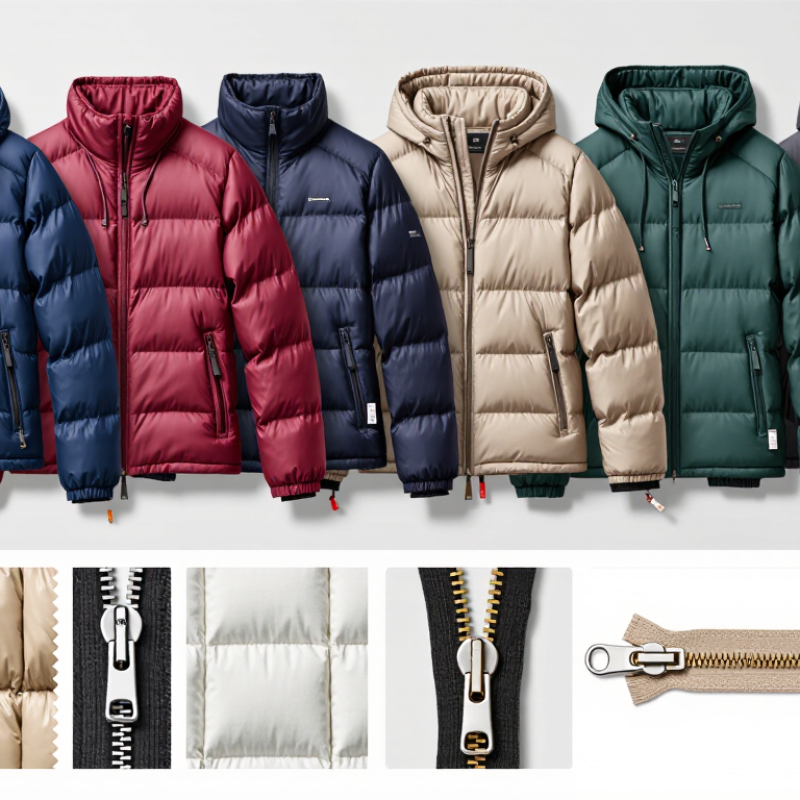
Top Custom Puffer Jackets for Global Buyers

What Defines a High-Quality Custom Puffer Jacket

In my sampling experience, a high-quality custom puffer jacket starts with insulation, not decoration. For consistent warmth, buyers should compare fill power, fill weight, and recovery after compression. High fill power feels light, but sufficient fill weight matters in cold, windy regions. Ask for test records and inspect the jacket after repeated packing. Small checks matter.

The shell fabric should resist light rain, abrasion, and feather leakage without feeling stiff. Even quilting keeps insulation distributed across the body, sleeves, and hood. Cold spots happen. Examine seam density, thread tension, zipper smoothness, and cuff recovery by hand. For custom orders, the pattern must match the approved size chart, including layering space. That detail is often missed.

Reliable production also requires traceable materials, stable color matching, and clear inspection standards. Request a pre-production sample, wash or abrasion testing, and photos from final inspection. A supplier may provide attractive samples, yet bulk garments can vary. I have seen this gap appear when deadlines replace measurement checks. No sample is perfect, so measurements deserve another review after approval. Build tolerance limits into the purchasing agreement. Do not trust appearance alone.

Key Materials, Insulation Types, and Weather Performance

Custom puffer jackets perform well when their materials match the intended climate. A tightly woven nylon or polyester shell resists wind and light rain. Recycled fabrics can offer dependable strength, but quality varies between mills. Ask for abrasion, colorfastness, and water-repellent testing before bulk production. A durable water-repellent finish helps droplets bead on the surface. It does not make the jacket waterproof.

Insulation determines warmth, weight, and drying speed. Responsibly sourced down provides excellent warmth with low bulk, especially at higher fill powers. However, damp conditions can reduce its loft and comfort. Synthetic insulation keeps insulating better after light moisture exposure and usually dries faster. It may feel heavier at the same warmth level. Baffle size, stitch spacing, and fill distribution also matter. Cold spots often appear near seams, cuffs, or poorly filled panels. I have seen impressive samples lose warmth because the hood and hem were under-insulated. More fill is not always better; poor pattern balance can restrict movement.

Tips: Test samples in wind, drizzle, and cool indoor storage. Check whether the shell feels noisy or stiff. Measure loft after compression and again after recovery. Confirm insulation weight, not only its marketing description. A higher fill-power number alone does not guarantee better weather performance. Regional fit testing is wise, though buyers sometimes skip it to reduce costs. That shortcut can create returns, discomfort, and avoidable production changes.

Customization Options for Branding, Design, and Fit

Top Custom Puffer Jackets for Global Buyers

Customization Options for Branding, Design, and Fit

For global buyers, a custom puffer jacket should communicate identity before customers read the label. Embroidery works well on the left chest, while heat-transfer graphics suit larger back panels. Keep artwork between 8 and 10 centimeters wide for cleaner stitching. Small details matter.

The fabric decision also affects the product story. Textile Exchange’s Materials Market Report 2024 reported polyester at approximately 57% of global fiber production in 2023. Buyers can request recycled polyester shells, traceable insulation, and clear fiber documentation. However, recycled content alone does not prove better performance. Wind resistance, water repellency, seam construction, and wash testing still need verification. A glossy finish may photograph well, but it can look inexpensive under strong warehouse lighting.

Fit requires measurable discipline. Request a complete size chart, graded measurements, sleeve specifications, and a physical sample before bulk production. The NRF and Appriss Retail 2023 report estimated that 14.5% of retail sales were returned in 2022. Poor sizing can quietly increase this risk. Offer regular, relaxed, and extended fits when the target market supports them. A useful fitting session includes a sweater underneath, seated movement, and raised arms. We sometimes overvalue a perfect mannequin fit. Real buyers bend, layer, and carry bags. A second sample may reveal uncomfortable armholes or a hood that blocks peripheral vision.

Global Sourcing Standards, Certifications, and Quality Control

Custom puffer jackets require more than attractive designs and low factory prices. Global buyers should request documented standards, test reports, and traceable production records. ISO Survey data shows millions of organizations use ISO 9001-certified quality systems worldwide, making it a practical benchmark for supplier evaluation. However, certification alone does not guarantee a warm, durable jacket.

For insulation, ask suppliers to identify fill composition, fill power, and down-to-feather ratios. The Responsible Down Standard supports animal-welfare controls and supply-chain traceability for down products. Recycled synthetic fill should include recognized recycled-content verification. OEKO-TEX Standard 100 testing can help screen fabrics, trims, and finished garments for harmful substances. Test zipper strength, seam slippage, colorfastness, water resistance, and thermal performance before bulk production. Small details matter. A failed cuff can ruin a shipment.

Tips: Require a pre-production sample, a sealed reference sample, and an inspection plan. Use AQL-based checks for defects, measurements, labeling, and carton packing. Textile Exchange’s Materials Market Report 2024 reported that recycled polyester represented a significant share of global polyester production, yet most polyester remained fossil-based. This distinction deserves careful review. Ask for transaction certificates, not only attractive sustainability claims. Independent laboratory testing is safer than factory promises. I have seen specifications pass on paper but fail after repeated washing; buyers should test real use, not only fresh samples. Perfect control is unrealistic, so record every deviation and improve the next production cycle.

Top Custom Puffer Jackets for Global Buyers

Global sourcing benchmarks for fill power, certifications, and quality control

Fill power values of 550, 650, 700, and 800 cuin are commonly specified commercial performance bands for down and feather insulation. Actual performance should be verified through recognized laboratory methods such as EN 12130 or IDFB procedures. Global buyers should also confirm applicable certifications, including RDS for responsible down sourcing, OEKO-TEX STANDARD 100 for harmful-substance testing, and ISO 9001-based quality management, together with inspections for measurements, seam strength, colorfastness, filling distribution, and final appearance.

How to Select the Right Custom Puffer Jacket Supplier

Top Custom Puffer Jackets for Global Buyers

Choosing the right custom puffer jacket supplier requires more than comparing unit prices. Request a physical sample before approving bulk production. Examine the shell fabric under bright light. Check zipper movement, seam strength, pocket placement, and filling distribution. A jacket may look attractive in photographs but feel thin in hand. That difference matters.

Ask suppliers for factory details, production capacity, quality-control procedures, and recent inspection records. Confirm the filling type, fabric weight, size measurements, color standards, and care-label information in writing. Reliable suppliers explain their minimum order quantity and production timeline clearly. They should also provide a sample revision process. Communication is evidence.

Test samples in realistic conditions. Wear one over a sweater and inspect the shoulder fit. Compress the jacket inside a travel bag, then check whether it regains its shape. I once underestimated pocket depth, and the finished design felt less practical than expected. Small details can weaken a strong concept. Allow time for corrections, especially when multiple sizes are involved. Suppliers who welcome precise feedback usually support more consistent results.

Top Custom Puffer Jackets for Global Buyers - How to Select the Right Custom Puffer Jacket Supplier

Selection Dimension Practical Benchmark for Global Buyers Why It Matters What to Verify with the Supplier Suggested Buyer Score
Insulation Type Choose responsibly sourced down, recycled synthetic fill, or a blended construction according to climate, budget, and care requirements. Down generally provides high warmth at low weight, while synthetic insulation performs more consistently in damp conditions and is easier to wash. Request the insulation composition, percentage by weight, product specification sheet, and a physical sample. 1–5 points based on suitability for the target market.
Down Fill Power Common commercial ranges are approximately 550–800+ fill power. Compare products only when the measurement method and test conditions are consistent. Higher fill power can provide more loft and warmth for the same weight, but it does not alone determine total garment warmth. Ask for the stated fill power, test method, down-to-feather ratio, and independent laboratory documentation where available. 1–5 points for documented performance and clear labeling.
Warmth Construction Use baffle construction for improved loft retention and reduced cold spots; sewn-through construction may be lighter and more economical. Panel design affects heat distribution, appearance, weight, and manufacturing cost. Review the technical drawing, baffle dimensions, insulation distribution, seam placement, and a completed sample. 1–5 points for construction quality and design suitability.
Outer Fabric Typical options include nylon or polyester shells with a specified denier, weave, coating, and water-repellent finish. Fabric selection influences abrasion resistance, weight, hand feel, wind resistance, color appearance, and weather performance. Confirm fiber content, fabric weight, tear strength, colorfastness, coating details, and test reports relevant to the destination market. 1–5 points for performance, consistency, and specification transparency.
Water Repellency A durable water-repellent finish can help rain bead on the shell, but it does not make a puffer jacket fully waterproof. Moisture can reduce comfort and may affect the loft and drying time of down insulation. Request spray-rating or equivalent test data, care instructions, and confirmation of the finish chemistry where required by law. 1–5 points for realistic claims and verified performance.
Sizing and Fit Use a measurement chart in centimeters or inches with tolerance limits, graded sizes, and a clearly defined fit profile. Regional body measurements and layering habits vary, so an accurate size set reduces returns and production corrections. Approve a size specification, pre-production sample, measurement tolerance, and fit sample on an appropriate model. 1–5 points for measurement accuracy and sample approval control.
Customization Capability Assess capability for color matching, quilting patterns, labels, trims, embroidery, printing, packaging, and special size ranges. A supplier must be able to reproduce the approved design consistently, not just create one attractive sample. Ask for a tech-pack review, artwork requirements, color approval process, sample revisions, and production quality checkpoints. 1–5 points for design execution and repeatability.
Minimum Order Quantity Compare minimum quantities separately for each color, size range, fabric, and custom trim. Smaller trial orders may carry higher unit costs. MOQ affects inventory risk, color assortment, cash flow, and the feasibility of market testing. Obtain written MOQ terms, sample charges, size-ratio requirements, and any surcharge for low-volume production. 1–5 points for commercial flexibility and cost clarity.
Lead Time Separate development, material sourcing, production, inspection, and transportation time. Seasonal capacity should be confirmed before booking. Puffer jackets are often seasonal products, so delays can cause missed selling periods and additional freight costs. Request a milestone schedule covering sample approval, fabric booking, bulk production, inspection, and shipment readiness. 1–5 points for realistic planning and schedule communication.
Quality Control A robust process should include incoming-material checks, in-line inspection, final inspection, measurement checks, and visual workmanship review. Quality controls help identify leakage, uneven filling, stitching defects, shade variation, and incorrect measurements before shipment. Ask for inspection procedures, acceptance criteria, defect classification, inspection records, and corrective-action handling. 1–5 points for documented and repeatable controls.
Compliance Documentation Documentation should match the destination market and may include fiber composition, care labeling, chemical compliance, product safety, and social-compliance records. Import and labeling requirements differ by country, and incomplete documentation can delay customs clearance or retail approval. Confirm applicable regulations, test scope, document validity, product traceability, and whether reports identify the actual production materials. 1–5 points for destination-market readiness.
Sourcing and Traceability For down products, request evidence of sourcing and animal-welfare controls. For recycled materials, request material-content and chain-of-custody documentation where applicable. Traceability supports responsible sourcing claims and reduces the risk of inaccurate product communication. Verify certificates, transaction records, supplier declarations, scope, expiry dates, and whether the documentation covers the finished product. 1–5 points for verifiable sourcing information.
Packaging and Shipping Agree on folding or compression limits, carton dimensions, moisture protection, carton markings, and shipping terms before production. Excessive compression can affect garment appearance, while poor packaging can increase transit damage and dimensional-weight charges. Request a packing specification, carton test information where needed, estimated carton count, gross weight, and shipping documents. 1–5 points for shipment protection and logistics accuracy.
Total Cost Transparency Compare the product price with sampling, custom development, testing, labels, packaging, inspection, duties, freight, and payment-related costs. The lowest unit quotation may not provide the lowest landed cost or the lowest quality risk. Request an itemized quotation, price validity period, payment terms, tooling charges, revision fees, and shipping assumptions. 1–5 points for complete and comparable pricing.

Buyer guidance: Score each supplier from 1 to 5 for every dimension, then prioritize insulation performance, construction quality, compliance documentation, quality control, and total landed cost rather than unit price alone.

FAQS

What makes a custom puffer jacket high quality?

Good insulation, balanced filling, durable fabric, and accurate sizing define quality. Appearance alone is not enough. Small checks matter.

Which insulation details should buyers compare?

Compare fill power, fill weight, composition, and recovery after compression. High fill power feels light, but cold regions may need more fill. Test it after packing.

How should the outer fabric be evaluated?

Inspect resistance to light rain, abrasion, and feather leakage. The fabric should feel protective without becoming stiff. Check it under bright light.

Why is quilting important in a puffer jacket?

Even quilting keeps insulation distributed across the body, sleeves, and hood. Uneven filling creates cold spots. This problem is easy to miss in photos.

What should buyers inspect on a physical sample?

Check seams, thread tension, zipper movement, cuffs, pockets, and filling distribution. Wear it over a sweater. Measure the shoulder fit again.

Which documents should a supplier provide?

Request material records, test reports, size charts, color standards, and inspection photos. Ask for traceable production details. Promises need evidence.

How can buyers control bulk production quality?

Approve a pre-production sample and seal a reference sample. Use written tolerance limits for measurements and defects. Record every deviation.

Should buyers rely on factory certifications alone?

No. Certifications can support evaluation, but they do not guarantee warmth or durability. Independent testing is safer. Test washing and abrasion too.

How can buyers test a jacket in realistic conditions?

Wear it over normal layers, place items inside the pockets, and compress it in a travel bag. Check shape recovery afterward. Test real use.

What common mistake should buyers avoid?

Do not approve bulk production from photographs alone. I once underestimated pocket depth, and the finished jacket felt less practical. Recheck important measurements.

Conclusion

Custom Puffer Jackets are defined by a balanced combination of durable outer fabrics, reliable stitching, effective insulation, and comfortable construction. Quality options should provide warmth without excessive weight, while offering suitable protection against wind, light rain, and changing temperatures. Buyers should compare insulation types such as down, synthetic fill, and blended alternatives according to climate, budget, care requirements, and performance expectations. Attention to lining, zippers, quilting, seam strength, and size consistency is also essential for long-term use.

For branding and product development, suppliers should support flexible choices in colors, logos, labels, patterns, pocket layouts, hood styles, and tailored fits. Global buyers should also review material documentation, testing procedures, factory standards, certifications, sample approval, production inspections, and packaging controls. The right supplier should communicate clearly, provide transparent lead times and pricing, maintain consistent quality across bulk orders, and offer dependable solutions for different markets. A careful evaluation process helps buyers achieve attractive, functional, and commercially reliable custom outerwear.

Isabella

Isabella

Isabella is a dedicated marketing professional with a profound expertise in the company's product offerings. With a passion for effective communication and strategy, she consistently updates the company's professional blog, sharing insights that reflect her deep understanding of market trends and......